let the river run to the sea
The notion of diverting water from the Clarence River catchment to other parts of Australia surfaces every few years. It usually gets dismissed as the hare-brained scheme of some mad old engineer or outback dinosaur mayor.
This time it feels different. A combination of factors – badly-planned urban growth in southeast Queensland, the upcoming Federal election and the drought– have led to the Clarence coming under the cold and acquisitive eye of the Federal government and its engineers.
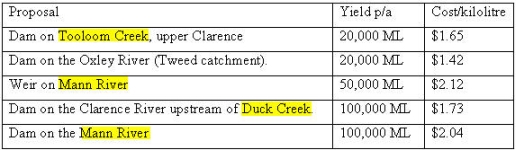
Minister for Environment and Water Resources Malcolm Turnbull commissioned the Snowy Mountains Engineering Corporation to do a ‘short term desk-top review on the identification and definition of issues associated with improving urban water supply security in South East Queensland and North East New South Wales by accessing water from the Northern Rivers of NSW.’ The resulting SMEC Report is available here. The report recommends five options for investigation:
The Clarence options include a pipeline to the Logan River. The Tweed option has a pipe to the Nerang River. The report describes the dam upstream of Duck Creek as the best value for money. It’s clear the options have been chosen purely on an engineering basis without any analysis of environmental or Aboriginal cultural issues.
The SMEC report has met with alarm from locals. The Clarence Valley Council resolved to oppose any diversion proposal. The Daily Examiner launched its Not A Drop campaign. Nationals state MP Steve Cansdell and Nationals federal candidate Chris Gulaptis squirmed and declared their opposition to diversion, quite a feat given their party’s coalition partner status. There have been rival petitions, and much talk of staunchly standing shoulder to shoulder. In the Tweed a group has formed to resist any Oxley dam proposal.
While Turnbull claims they are not proposals, the Federal Government is planning further assessment of the five options. A public hearing into water supply options for southeast Queensland began in Canberra on 4 June. The CEC sent a submission which raises the following concerns about the SMEC report: The philosophical dimension
The transfer of water away from the Clarence catchment started with the completion of the pipeline to Coffs Harbour. Coffs Harbour is not in the Clarence catchment. This didn’t seem to bother most people outside the environment movement. Maybe this was because it was only the Nymboida rather than ‘our mighty Clarence’, or maybe because people didn’t mind helping our neighbours in Coffs Harbour. The SMEC proposals have aroused some deeply parochial attitudes locally. The parochialism is characterised by a possessive stance about ‘our’ water which exists purely for ‘our’ use, and by a resentment of any Queenslanders or Bourke farmers who might ‘steal’ this water. The Environment Centre’s interest in the river is based on the premise that the Clarence River catchment has its own intrinsic natural values which need to be defended by us humans. In other words, we are not interested in the concept of ‘our’ water. We are interested in river flows staying in the catchment to fulfil their ecological role. We will be campaigning against any proposal.
The political dimension
Page is classified as a marginal National Party seat, with a soon-to-retire incumbent. Southeast Queensland including Brisbane is a mixture of Liberal and Labor seats. Would Queenslanders vote en masse for Howard if he promises a water solution for a small but densely populated part of their state? If water diversion is an election issue this year in Page, will voters in the Lismore part of the electorate care? Premier Iemma is against it. So is federal Labor’s Anthony Albanese. Is it a big wedge? The political angle is an obtuse one. Meanwhile, Independent NSW MP for Port Macquarie Robert Oakeshott has sought a ruling from the Attorney General and Crown Solicitor over a section of the constitution which states the Commonwealth cannot, by law, abridge state rights on the ‘reasonable’ use of river waters.
The community dimension
The Clarence River system is valued by many, for many different reasons. Aboriginal communities, the fishing industry, farmers, canoeists, the tourist industry: they all have an interest in the river system maintaining its natural flows. According to the Clarence Professional Fisherman’s Association, fisheries management has three basic rules: habitat, habitat and habitat. It’s certain that if any of the Clarence proposals go any further, a wide coalition of interest groups will be likely to come together to defend the river. Maybe it will do the community good to campaign together. The Environment Centre is linking up with other interested groups as a preliminary move.
The ecological dimension
According to the Healthy Rivers Commission Final Report into the Clarence River System 1999, ‘any proposal to divert substantial volumes of water from the Clarence is likely to present significant risks to the health of the river system.”
Even though the odd ignoramus is heard to lament the ‘wasted’ water flowing out to sea every time it rains, there is a growing community understanding that the river’s natural flow regime is never wasteful. Floods are important for rejuvenating ecosystems, especially the floodplain and wetlands. Freshes (when rivers rise but don’t flood) expand habitats and food sources and provide breeding opportunities for fish and macro-invertebrates. Low flows are needed to prevent those species which do best in stable conditions from dominating and creating an imbalance. Maybe we humans need to think about that.